
Landlord Deposit Protection: The 30-Day Rules
Protect the deposit and give the prescribed information within 30 days. The cap, the holding deposit, returning it, and the penalties.

This is the position on 25 October 2026, England.
Which deposits must be protected?
Any deposit taken for an assured tenancy must be protected in an approved scheme. That includes a deposit paid by someone else, such as a parent or a rent deposit scheme.
A holding deposit, paid to reserve a property before the agreement is signed, does not have to be protected.
The key numbers
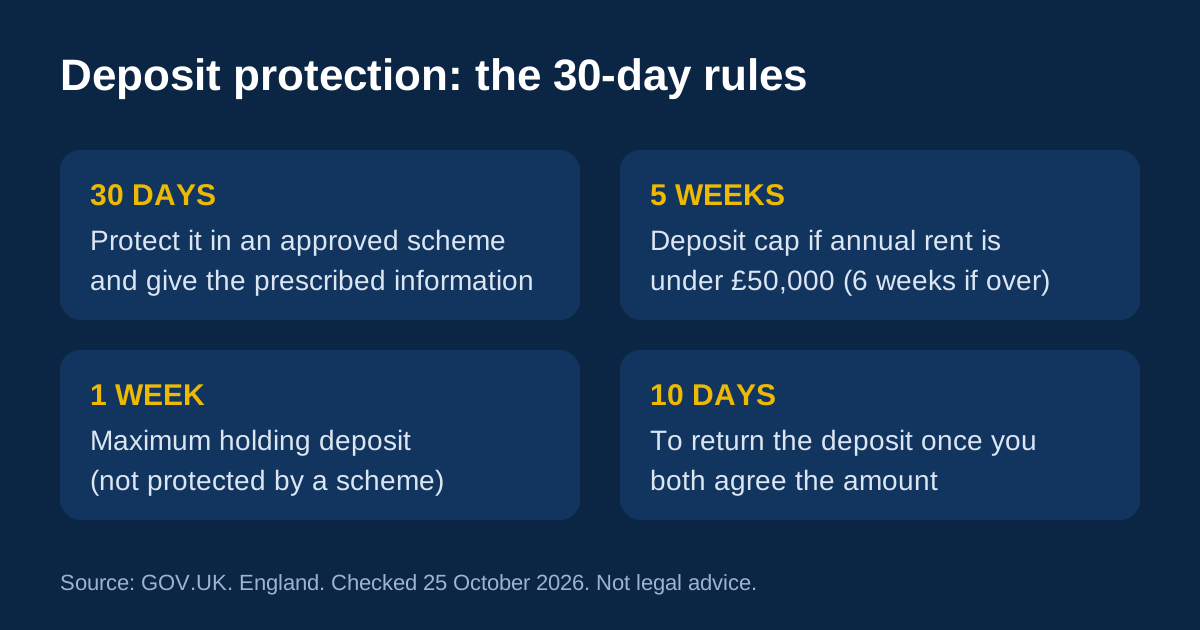
| Rule | What it says |
|---|---|
| Protect it | In an approved scheme within 30 days of receiving it |
| Tell the tenant | The prescribed information within 30 days |
| Deposit cap | 5 weeks' rent if annual rent is under £50,000; 6 weeks' if £50,000 or more |
| Holding deposit | No more than 1 week's rent |
| Return it | Within 10 days of agreeing the amount |
Step 1: Choose a scheme
GOV.UK lists the government-backed schemes, such as the Deposit Protection Service and the Tenancy Deposit Scheme. You or your letting agent pay the deposit in, or register it, within 30 days.
Step 2: Give the prescribed information
Within the same 30 days you must tell the tenant:
- how much deposit they paid
- how it is protected
- the scheme's name, contact details and dispute resolution service
- the name and contact details of any third party who paid the deposit
- why you might keep some or all of it
Keep proof of the date you sent it. Our free Section 8 guide explains why this matters if you ever need possession.
Step 3: Stay within the cap
You must not ask for more than five weeks' rent as a deposit where annual rent is under £50,000, or six weeks' where it is £50,000 or more.
With joint tenants, the cap applies to the total rent for the property, not to each person. For example, three tenants sharing £240 a week can be asked for £1,200 in total.
Step 4: Return it on time
Return the deposit within 10 days of you and the tenant agreeing how much they get back. If you disagree, it stays protected in the scheme until the dispute is settled.
What happens if you get it wrong?
- A prohibited payment (for example an excess deposit): a financial penalty from the council, and for repeat breaches up to £30,000 or prosecution.
- A holding deposit not returned in time: a financial penalty of up to £5,000.
- Possession: on most grounds the deposit must be protected and the information given before the court can make an order. See Section 8 Ground 8 for how this fits in.
Track it in Landlord Junction
The deposit protection area records when you received each deposit and shows how many days are left to protect it. The daily reminder emails also include deposit deadlines, so a 30-day clock does not slip past. It is a record and a reminder. It does not register the deposit for you: you still do that with your scheme.
For other dates, see Landlord gas safety check: dates, records, tracking.
Checklist: deposit protection (copy it)
- [ ] Date the deposit was received
- [ ] Scheme chosen, and the date it was protected (within 30 days)
- [ ] Prescribed information sent, with proof of the date
- [ ] Deposit within the 5 or 6 week cap
- [ ] Any non-money items recorded
- [ ] Reminder set for the end of the tenancy and the 10 day return
Read the rules at source: Deposit protection schemes and landlords and Information landlords must give tenants.
England only. General information, not legal advice. Checked against GOV.UK on 25 October 2026.







Frequently asked
How long do I have to protect a deposit?
30 days from receiving it. You or your letting agent must put it in a government-approved tenancy deposit scheme within that time.
What information must I give the tenant?
Within 30 days: how much they paid, how it is protected, the scheme's name and contact details and its dispute service, details of any third party who paid, and why you might keep some or all of it.
What is the maximum deposit?
Five weeks' rent if the annual rent is under £50,000, or six weeks' rent if it is £50,000 or more. A holding deposit is capped at one week's rent.
When must I return the deposit?
Within 10 days of you and the tenant agreeing how much they get back. If there is a dispute, it stays protected in the scheme until it is settled.
Does it matter for possession?
Yes. On most grounds the deposit must be protected and the prescribed information given before the court can make a possession order.
Sources
- Deposit protection schemes and landlords — GOV.UK
- Tenancy deposit protection: information landlords must give tenants — GOV.UK
- Tenant Fees Act 2019: statutory guidance for enforcement authorities — GOV.UK
- Repossessing your privately rented property after 1 May 2026 — GOV.UK
- Check your landlord has protected your deposit — Citizens Advice
- Tenancy deposits — Shelter England
- Legal and regulation hub — NRLA
Read next
More landlord news

Stay ahead of the next deadline.
Certificate reminders, rent and arrears records, and an evidence trail. Every account starts with 27 days of everything, no card.
Start freeGoing for possession in England?
The Possession & Compliance Playbook: 31 pages on Section 8 after the Renters' Rights Act. One-off £29, instant PDF.
See the PlaybookEducation Hub