
Landlord Tax Tips & Deductions
Section 24 Explained: Landlord Tax from April 2027
How mortgage interest relief works for individual landlords, the new property income tax rates from 6 April 2027, and a worked example.

"Section 24" is the landlord shorthand for the rule that restricts mortgage interest relief. This is the position on 29 October 2026, after the Budget on 28 October.
What is Section 24?
It applies to individuals who let residential property. It does not apply to companies.
You cannot deduct finance costs such as mortgage interest when you work out your rental profit. You work out tax on the profit, then take a tax reduction off the bill.
How the tax reduction is worked out
The reduction is calculated at the basic rate on the lowest of three amounts:
- your finance costs (including any brought forward)
- your property business profits for the year
- your adjusted total income above the personal allowance
If the reduction is limited because profits or income are lower than your finance costs, the excess is carried forward to later years.
That is why the reduction is not always a flat 20% of your interest. See HMRC's own page: Tax relief for residential landlords: how it's worked out.
What changes on 6 April 2027?
Property income will have its own separate rates. It is taxed after your other income and before savings and dividends.
| Property income rate | From 6 April 2027 |
|---|---|
| Property basic rate | 24% |
| Property higher rate | 44% |
| Property additional rate | 49% |
These are the rates confirmed in the Budget on 28 October 2026, 2 points higher than the 22%, 42% and 47% announced a year earlier.
The finance cost reduction will be given at the property basic rate, 24%. The property allowance and the Rent a Room Scheme are unchanged, and carried-forward property losses must still be set against property income. National Insurance treatment does not change.
The new rates are in the Budget 2026 overview of tax legislation and rates. HMRC explains how the separate rates work in its technical note.
A worked example
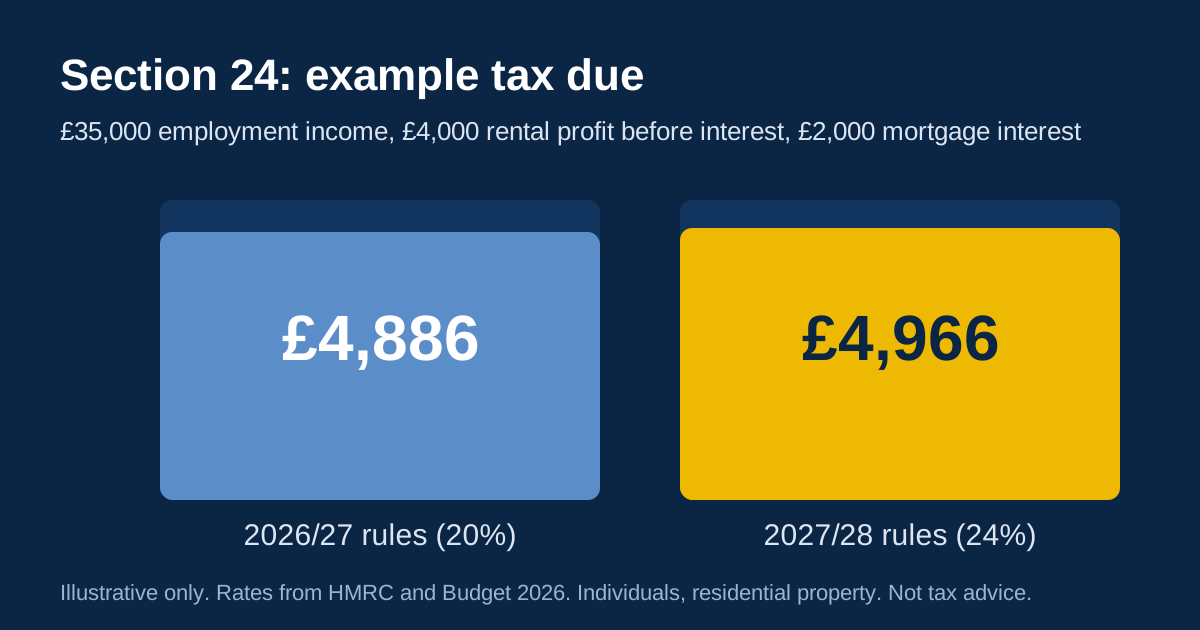
An individual has employment income of £35,000, rental profit before mortgage interest of £4,000, and £2,000 of mortgage interest. England, personal allowance £12,570 used against employment income first.
| 2026/27 rules | 2027/28 rules | |
|---|---|---|
| Taxable income after the personal allowance | £26,430 (employment £22,430 plus property £4,000) | £26,430 (the same) |
| Tax before relief | £26,430 at 20% = £5,286 | Employment £22,430 at 20% = £4,486, plus property £4,000 at 24% = £960, so £5,446 |
| Finance cost reduction on £2,000 | -£400 (20%) | -£480 (24%) |
| Tax due | £4,886 | £4,966 |
In this example the change adds about £80. The change is larger when your property profit is large compared with your interest. Use the example for the method, not as a forecast.
How we got here
The restriction was phased in. It started in 2017/18 and has been fully in place since 6 April 2020.
| Tax year | Finance costs deducted from rental income | Given as a basic rate tax reduction |
|---|---|---|
| 2017/18 | 75% | 25% |
| 2018/19 | 50% | 50% |
| 2019/20 | 25% | 75% |
| 2020/21 onwards | 0% | 100% |
A quick way to estimate your own relief
- Add up your finance costs for the year, plus any brought forward.
- Work out your property business profit and your income above the personal allowance.
- Take the lowest of the three figures.
- Multiply it by 20% for 2026/27, or 24% from 2027/28.
That is your tax reduction. Anything left over is carried forward. This is a rough guide. Your accountant should confirm the figure.
Common questions
Does this apply to my limited company?
No. The restriction and the new property rates are for individuals. A company is taxed differently. Ask your accountant which structure suits you.
Does my personal allowance change?
From April 2027, available allowances and reliefs must be set against income that is not property, savings or dividend income first. Only what is left can be set against property income.
Do I still file a Self Assessment return?
Yes, if you meet the criteria. HMRC says to continue to register for and file Self Assessment as before.
What should you do?
- Keep finance costs separate from other expenses. They are treated differently.
- Keep digital records. From April 2026, landlords with qualifying income above £50,000 need digital records and quarterly updates to HMRC.
- Try your own numbers in our free rental income tax calculator. It has both 2026/27 and the announced 2027/28 rates.
- Check the deal, not only the tax. Our rental yield calculator and stamp duty calculator show the other costs.
- Check your rents. See What are tenants really paying in your area? before you set a rent.
How Landlord Junction helps
The accountant export includes an SA105 summary that lists finance costs on their own line. There are also CSVs for Xero, QuickBooks, Sage and FreeAgent. It is an export to help your accountant. It is not HMRC-recognised software.
Checklist: Section 24 records to keep (copy it)
- [ ] Mortgage statements showing interest paid in the tax year
- [ ] Rental income by property, with dates
- [ ] Other allowable expenses, kept apart from finance costs
- [ ] Any finance costs brought forward from earlier years
- [ ] Your other income for the year, so you can see the total
- [ ] Digital records if your qualifying income is above £50,000
England, Wales and Northern Ireland rules; individuals only, not companies. General information, not tax advice. Checked against HMRC and HM Treasury publications on 29 October 2026.







Frequently asked
Can I still deduct mortgage interest from my rental profit?
Not if you are an individual with residential property. You cannot deduct finance costs as an expense. You get relief as a tax reduction at the basic rate instead.
What changes in April 2027?
Property income gets its own rates: 24% basic, 44% higher and 49% additional, from 6 April 2027. The 28 October 2026 Budget added 2 points to the rates announced a year earlier. Finance cost relief is given at the property basic rate, so 24%.
Is the tax reduction always the full 20% of my interest?
No. It is 20% of the lowest of your finance costs, your property business profits, and your adjusted total income above the personal allowance. Any excess finance costs can be carried forward.
Does this affect Scotland?
The separate property rates apply to England, Wales and Northern Ireland. The government has given the Scottish and Welsh governments the ability to set their own property income rates.
Does Making Tax Digital change?
No. From April 2026, landlords with qualifying income above £50,000 need digital records and quarterly updates. These rate changes do not affect that.
Sources
- Budget 2026: overview of tax legislation and rates — HM Treasury, GOV.UK
- Changes to tax rates for property, savings and dividend income — HMRC, GOV.UK
- Change to tax rates for property, savings and dividend income: technical note — HMRC, GOV.UK
- Tax relief for residential landlords: how it's worked out — HMRC, GOV.UK
- Tax guidance for landlords — NRLA
- HM Revenue and Customs — GOV.UK
Read next
Stay ahead of the next deadline.
Certificate reminders, rent and arrears records, and an evidence trail. Every account starts with 27 days of everything, no card.
Start freeGoing for possession in England?
The Possession & Compliance Playbook: 31 pages on Section 8 after the Renters' Rights Act. One-off £29, instant PDF.
See the PlaybookEducation Hub